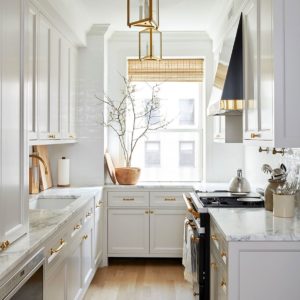

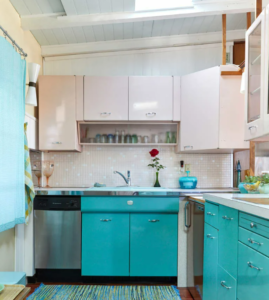
“Stickler spent five years sourcing the most period-aligned steel cabinets for her home and picked materials from seven different cities. Most of the cabinets were made by Geneva Kitchens (which she notes also outfitted the White House kitchen when John F. Kennedy was president) in 1960, which Stickler snagged from Craigslist.
The two-toned cabinets, which Stickler says were a “short-lived” trend, are their original colors. The upper cabinets are a soft pastel pink, while the base cabinets are painted in vibrant turquoise. But the historic inclusions didn’t stop at the cupboards. Stickler also found and stitched together pieces of vintage Formica in “White Skylark” (designed by Raymond Lowey) for the counters in her kitchen.”
Click here to read the full story.
 A client of mine once raised a good question: “Do upper cabinets have to be installed the standard 18 inches off the countertop?” It got me thinking outside of the usual cabinetry box. Of course there are lots of ways to install your upper cabinets, and if you’re willing to have an open mind, you might find that elevating them comes with unexpected benefits. Here are situations where you might want to hang your cabinets a little higher.
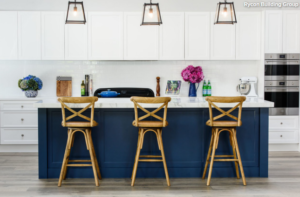
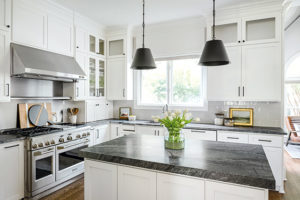 Often defined and characterized by their foundation of white cabinetry, a white kitchen’s impartial palette gives it a go-with-anything neutrality that can serve as a backdrop for the introduction of color and personality via other design elements. However, when combined with an abundance of white elements, especially countertops and backsplashes, white kitchens can turn into a monochromatic sea of sameness.